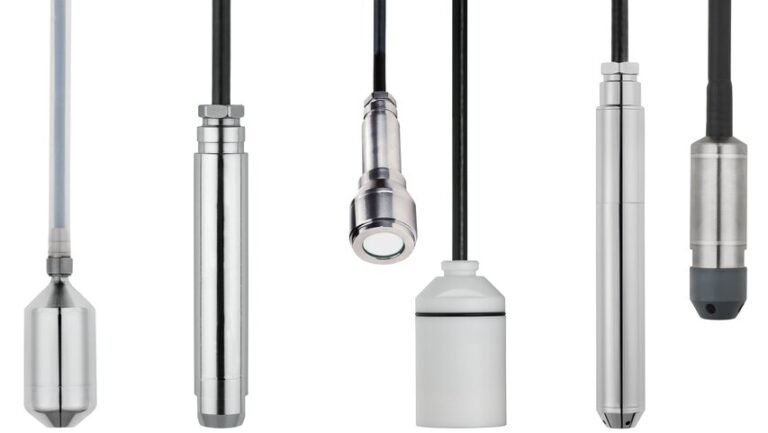
Hydrostatic Level Transmitter

Hydrostatic Level Transmitter

Hydrostatic Level Transmitter – Description

A Hydrostatic Level Transmitter is an instrument used to measure the level of liquids in tanks, reservoirs, wells, and open channels by sensing the hydrostatic pressure exerted by the liquid column above the sensor.

Principle of Operation

The transmitter operates on the principle that the pressure at a given depth in a liquid is directly proportional to the height of the liquid above it.

P = \rho g h

Where:

  • P = Hydrostatic pressure
  • ρ = Density of the liquid
  • g = Acceleration due to gravity
  • h = Height (level) of the liquid

The pressure sensor measures this hydrostatic pressure and converts it into an electrical output signal proportional to the liquid level.
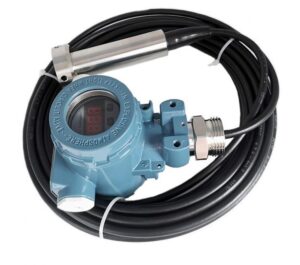
Construction


Image

Image

Image

Image

A typical hydrostatic level transmitter consists of:

  • Pressure sensing element (piezoresistive or capacitive sensor)
  • Stainless steel housing
  • Vent tube for atmospheric pressure compensation (gauge type)
  • Signal conditioning electronics
  • Electrical cable and process connection

Working

  1. The sensor is installed at the bottom of the tank or submerged in the liquid.
  2. The liquid column exerts pressure on the sensing diaphragm.
  3. The pressure sensor converts this pressure into an electrical signal.
  4. The transmitter outputs a standardized signal (typically 4–20 mA) corresponding to the liquid level.
  5. The control system displays or records the level measurement.

Advantages

  • Simple and reliable measurement method.
  • Suitable for deep wells, tanks, and reservoirs.
  • Continuous level measurement.
  • No moving parts, resulting in low maintenance.
  • Good accuracy and long-term stability.
  • Can be used in open or closed tanks.

Limitations

  • Measurement accuracy depends on liquid density.
  • Density changes due to temperature or composition can affect readings.
  • Sensor diaphragm may require protection in highly corrosive liquids.
  • Vent tube blockage can cause measurement errors.

Applications

  • Water storage tanks
  • Underground reservoirs
  • Bore wells and groundwater monitoring
  • Wastewater treatment plants
  • Chemical storage tanks
  • Fuel and oil tanks
  • Dams, rivers, and irrigation systems

Summary

A hydrostatic level transmitter measures liquid level by detecting the pressure created by the liquid column above the sensor. It is widely used for continuous level measurement in water, wastewater, chemical, and industrial storage applications because of its simplicity, reliability, and cost-effectiveness.

  • Information
  • Specification

Hydrostatic Level Transmitter – Information

A Hydrostatic Level Transmitter is an industrial measurement device used to determine the level of liquid in a tank or reservoir by measuring the pressure exerted by the liquid column.

It is widely used in water treatment plants, chemical industries, and storage tanks because it provides continuous, accurate, and reliable level measurement.


Working Principle

The transmitter works on hydrostatic pressure theory, where pressure increases with liquid height:

P = \rho g h

  • P = pressure at sensor
  • ρ = density of liquid
  • g = gravity
  • h = liquid level

The sensor measures pressure and converts it into an electrical signal proportional to level.


Construction

A hydrostatic level transmitter typically includes:

  • Pressure sensing diaphragm
  • Stainless steel housing (SS316L)
  • Submersible or top-mounted probe
  • Cable with optional vent tube (for atmospheric reference)
  • Electronic signal converter

Types

  • Submersible type transmitter
  • Vented (gauge pressure) type
  • Differential pressure-based systems

Key Features

  • Continuous level monitoring
  • No moving parts → low maintenance
  • Suitable for deep tanks and wells
  • Works in clean and dirty liquids
  • Easy installation

Advantages

  • High reliability
  • Cost-effective solution
  • Long service life
  • Suitable for harsh industrial environments
  • Compatible with automation systems (PLC/SCADA)

Limitations

  • Accuracy depends on liquid density
  • Vent tube (if present) must be protected
  • Not ideal for highly crystallizing or clogging media without proper design selection

Applications

  • Water and wastewater treatment plants
  • Bore wells and groundwater monitoring
  • Chemical storage tanks
  • Fuel and oil tanks
  • Reservoirs, dams, and irrigation systems

Summary

A hydrostatic level transmitter is a pressure-based instrument that converts liquid head pressure into level measurement. It is widely used due to its simplicity, durability, and suitability for continuous industrial monitoring.

Specification Typical Value
Measuring Principle Hydrostatic pressure sensing
Sensor Type Piezoresistive / Capacitive
Measuring Range 0–1 m to 0–100 m (or up to 0–10 bar)
Accuracy ±0.1% to ±0.5% FS
Repeatability ±0.1% FS
Output Signal 4–20 mA (2-wire), HART optional
Power Supply 12–30 VDC (typically 24 VDC)
Operating Temperature (Electronics) -10°C to +70°C
Process Temperature -20°C to +80°C (higher on special versions)
Pressure Overload 2× to 4× full scale
Protection Class IP68 (submersible type), IP65/IP67 (non-submersible)
Housing Material SS316L stainless steel
Diaphragm Material SS316L / Hastelloy / Ceramic
Cable Type PUR / PE cable with vent tube (gauge type)
Signal Damping Adjustable (0–30 sec typical)
Long-term Stability ±0.2% FS per year
Installation Type Submersible / flange / threaded mounting
Media Compatibility Water, wastewater, chemicals (based on material selection)
Calibration Factory calibrated, field adjustable
logo
Go Back Top