
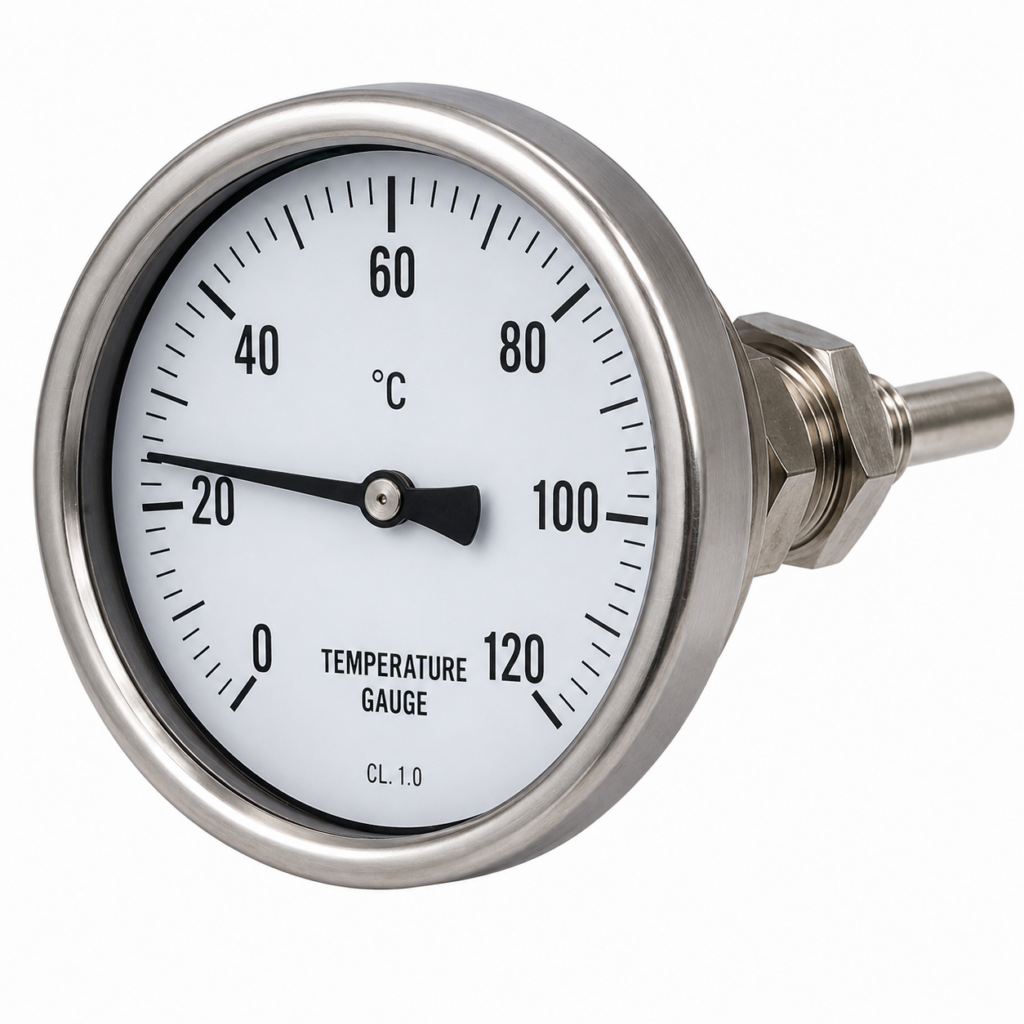
A Temperature Gauge is an instrument used to measure and display the temperature of gases, liquids, or solids in industrial processes, equipment, and environmental systems. It provides real-time temperature readings to ensure safe and efficient operation.
It works on different principles depending on the type, such as bimetallic expansion, gas-filled systems, or thermocouples/RTDs in electronic versions. The measured temperature is indicated either on an analog dial or a digital display.
Temperature gauges are widely used in boilers, pipelines, engines, HVAC systems, chemical plants, and storage tanks for monitoring and control purposes.
They are valued for their simplicity, reliability, and ability to operate in harsh industrial conditions without requiring complex power systems (especially mechanical types).
| Parameter | Specification |
|---|---|
| Type | Bimetallic / Gas Filled / Digital |
| Measuring Range | -50°C to 600°C (varies by model) |
| Accuracy | ±1% to ±2% FS |
| Dial Size | 63 mm, 100 mm, 150 mm (common) |
| Stem Length | 50 mm to 300 mm (customizable) |
| Connection Type | Bottom / Back / Adjustable angle |
| Process Connection | 1/2″ or 1/4″ BSP/NPT |
| Housing Material | Stainless Steel (SS304/SS316) |
| Probe Material | SS304 / SS316 |
| Display | Analog dial or digital LCD |
| Operating Pressure | Up to 10–25 bar (mechanical types) |
| Ambient Temperature | -20°C to +60°C |
| Application | Boilers, pipelines, tanks, HVAC systems |
