
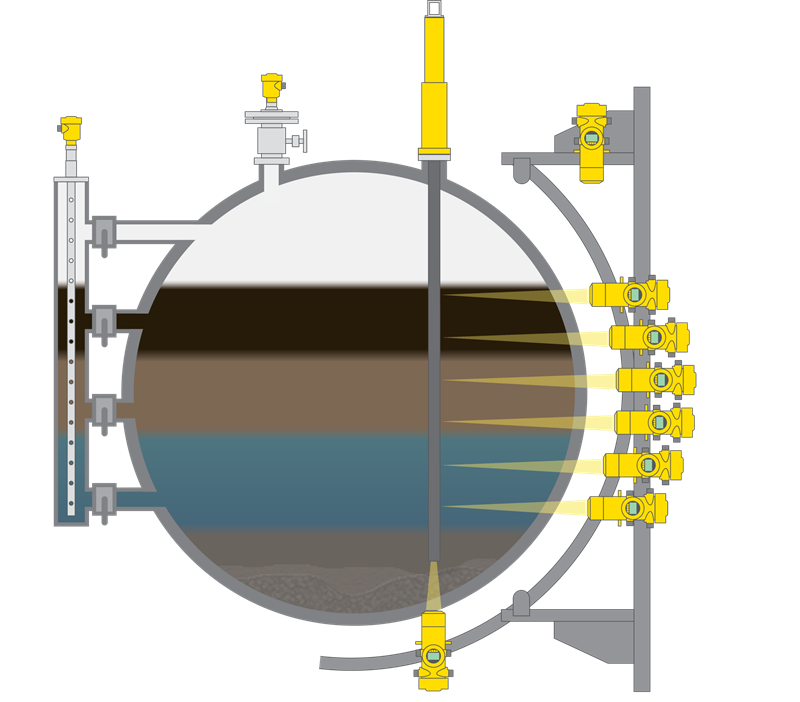
Interface Level Measurement is used to measure the level of separation (interface) between two immiscible liquids of different densities, such as oil and water, inside a tank or vessel. The instrument detects the boundary layer where the two liquids meet and continuously monitors its position.
This measurement is essential in applications where accurate separation of liquids is required, including oil-water separators, chemical processing vessels, desalters, and storage tanks. Various technologies such as Guided Wave Radar (GWR), Differential Pressure (DP) Transmitters, Displacers, and Capacitance Level Transmitters are commonly used for interface level measurement.
| Parameter | Specification |
|---|---|
| Measurement Type | Liquid-Liquid Interface Level |
| Technologies | GWR, DP, Capacitance, Displacer |
| Output Signal | 4-20 mA / HART / Modbus |
| Accuracy | Up to ±2 mm (depending on technology) |
| Process Temperature | Up to 400°C (model dependent) |
| Process Pressure | Vacuum to High Pressure Applications |
| Wetted Materials | SS316, Hastelloy, PTFE Coated |
| Applications | Oil-Water Separation, Chemical Tanks |
